
The Dover Bronze-Age Boat Reading Answers
IELTS Academic Reading Passage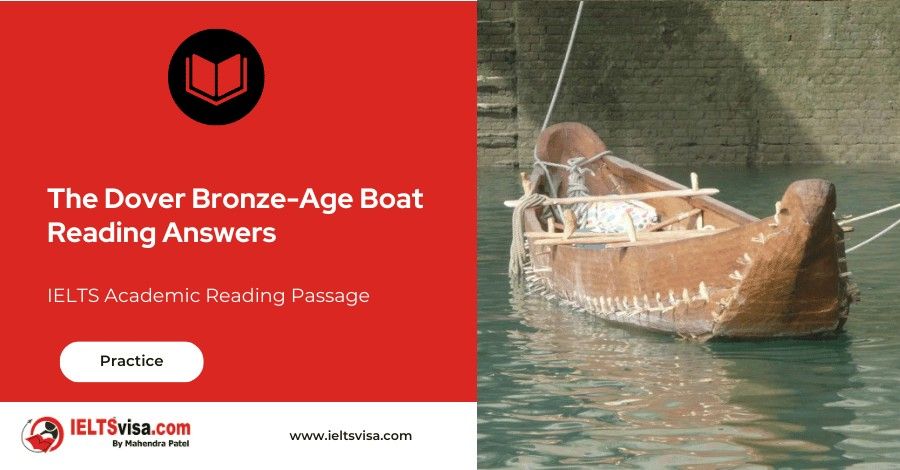
A beautifully preserved boat, made around 3,000 years ago and discovered by chance in a muddy hole, has had a profound impact on archaeological research.
It was 1992. In England, workmen were building a new road through the heart of Dover, to connect the ancient port and the Channel Tunnel, which, when it opened just two years later, was to be the first land link between Britain and Europe for over 10,000 years. A small team from the Canterbury Archaeological Trust (CAT) worked alongside the workmen, recording new discoveries bought to light by the machines.
At the base of the deep shaft six meters below the modern streets, a wooden structure was revealed. Cleaning away the waterlogged site overlying the timbers, archaeologists realized its true nature. They had found a prehistoric boat, preserved by the type of sediment in which it was buried. It was then named by Dover Bronze- Age Boat.
About nine meters of the boat’s length was recovered; one end lay beyond the excavation and had to be left. What survived consisted essentially of four intricately carved oak planks: two on the bottom, joined along a central seam by a complicated system of wedges and stitched to the others. The seams had been made watertight by pads of moss, fixed by wedges and yew stitches.
The timbers that closed the recovered end of the boat had been removed in antiquity when it was abandoned, but much about its original shape could be deduced. There was also evidence for missing upper side planks. The boat was not a wreck, but had been deliberately discarded, dismantled and broken. Perhaps it had been “ritually killed” at the end of its life, like other Bronze-Age objects.
With hindsight, it was significant that the boat was found and studied by mainstream archaeologists who naturally focused on its cultural context. At the time, ancient boats were often considered only from a narrower technological perspective, but news about the Dover boat reached a broad audience. In 2002, on the tenth anniversary of the discovery, the Dover Bronze-Age Boat Trust hosted a conference, where this meeting of different traditions became apparent. Alongside technical papers about the boat, other speakers explored its social and economic contexts, and the religious perceptions of boats in Bronze- Age societies. Many speakers came from overseas, and debate about cultural connections was renewed.
Within seven years of excavation, the Dover boat had been conserved and displayed, but it was apparent that there were issues that could not be resolved simply by studying the old wood. Experimental archaeology seemed to be the solution: a boat reconstruction, half-scale or full-sized, would permit assessment of the different hypotheses regarding its build and the missing end. The possibility of returning to Dover to search for a boat’s unexcavated northern end was explored, but practical and financial difficulties were insurmountable- and there was no guarantee that the timbers had survived the previous decade in the changed environment.
Detailed proposals to reconstruct the boat were drawn up in 2004. Archaeological evidence was beginning to suggest a Bronze- Age community straddling the Channel, brought together by the sea, rather than separated by it. In a region today divided by languages and borders, archaeologists had a duty to inform the general public about their common cultural heritage.
The boat project began in England but it was conceived from the start as a European collaboration. Reconstruction was only part of a scheme that would include a major exhibition and an extensive educational and outreach programme. Discussions began early in 2005 with archaeological bodies, universities and heritage organizations either side of the Channel. There was much enthusiasm and support, and an official launch of the project was held at an international seminar in France in 2007. Financial support was confirmed in 2008 and the project then named BOAT 1550BC got under way in June 2011.
A small team began to make the boat at the start of 2012 on the Roman Lawn outside Dover museum. A full- scale reconstruction of a mid-section had been made in 1996, primarily to see how Bronze- Age replica tools performed. In 2012, however, the hull shape was at the centre of the work, so modern power tools were used to carve the oak planks, before turning to prehistoric tools for finishing. It was decided to make the replica haft-scale for reasons of cost and time, any synthetic materials were used for the stitching, owing to doubts about the scaling and tight timetable.
Meanwhile, the exhibition was being prepared ready for opening in July 2012 at the Castle Museum in Boulogne-sur-Mer. Entitled ‘Beyond the Horizon: Societies of the Channel & North Sea 3,500 years ago’ it brought together for the first time a remarkable collection of Bronze- Age objects, including many new discoveries for commercial archaeology and some of the great treasure of the past. The reconstructed boat, as a symbol of the maritime connections that bound together the communities either side of the Channel, was the centrepiece.
Questions 1-5
Complete the chart below. Choose ONE WORD ONLY from the text for each answer.
Write your answers in boxes 1-5 on your answer sheet.
Key events
1992- the boat was discovered during the construction of a 1……………
2002-an international 2…………… was held to gather information
2004- 3……………. for the reconstruction were produced
2007- the 4…………… Of BOAT 1550BC took place
2012- the Bronze-Age 5…………… featured the boat and other objects
Questions 6-9
Do the following statements agree with the information given in the text?
In boxes 6-9 on your answer sheet, write
TRUE if the statement agrees with the information
FALSE if the statement contradicts the information
NOT GIVEN if there is no information on this
6. Archaeologists realized that the boat had been damaged on purpose.
7. Initially, only the technological aspects of the boat were examined.
8. Archaeologists went back to the site to try and find the missing northern.
9. Evidence found in 2004 suggested that the Bronze-Age Boat had been used for trade.
Questions 10-13
Answer the questions below.
Choose NO MORE THAN THREE WORDS AND/OR A NUMBER from the text for each answer.
Write your answers in boxes 10-13 on your answer sheet.
10. How far under the ground was the boat found?
11. What natural material had been secured to the boat to prevent water entering?
12. What aspect of the boat was the focus of the 2012 reconstruction?
13. Which two factors influenced the decision not to make a full-scale reconstruction of the boat?

Solution For: The Dover Bronze-Age Boat
Reading Answers
| 1. road | 2. conference |
| 3. proposals | 4. launch |
| 5. exhibition | 6. TRUE |
| 7. FALSE | 8. FALSE |
| 9. NOT GIVEN | 10. 6/six meters/meters/m |
| 11. (pads of) moss | 12. (the) hull (shape) |
| 13. cost and time |
Review and Practice
- Regularly practice with IELTS reading samples and time yourself to get used to the pressure of the exam.
- Review your mistakes to understand where you went wrong and how to avoid similar errors in the future.
Our Books

Master IELTS Speaking Part 1
IELTS Writing Task 1 Book
IELTS Writing Task 2 Book
The Dover Bronze-Age Boat Reading Answers Explanation
Comin Soon
Practice IELTS Other Modules
IELTS Listening
The IELTS Listening test assesses how well you can understand spoken English in various contexts. It lasts about 30 minutes and is divided into four sections with a total of 40 questions. The listening tasks become increasingly difficult as the test progresses.
IELTS Academic Reading
The IELTS Academic Reading section assesses your ability to understand and interpret a variety of texts in academic settings. It is designed to evaluate a range of reading skills, including skimming for gist, reading for main ideas, reading for detail, understanding inferences, and recognizing a writer's opinions and arguments.
IELTS Speaking
The IELTS Speaking test assesses your ability to communicate in English on everyday topics. It lasts 11-14 minutes and consists of three parts: introduction, cue card, and a discussion based on the cue card topic.
IELTS General Reading
IELTS General Reading tests your ability to understand and interpret various types of texts. Here are some key areas and types of content you can expect to encounter in the reading section, along with tips for effective preparation.
IELTS Academic Writing Task 1
In IELTS Academic Writing Task 1, you are presented with a visual representation of information, such as graphs, charts, tables, or diagrams, and you are required to summarize, compare, or explain the data in your own words.
IELTS General Writing Task 1
In IELTS General Writing Task 1, you are required to write a letter based on a given situation. The letter can be formal, semi-formal, or informal, depending on the prompt. Here’s a breakdown of the key components to include in your letter
IELTS Academic Writing Task 2
In IELTS Academic Writing Task 2, you are required to write an essay in response to a question or topic. Here’s a guide to help you understand the essential elements of this task
IELTS Exam Tips
To succeed in the IELTS exam, practice regularly, familiarize yourself with the test format, improve your vocabulary, develop time management skills, and take mock tests to build confidence.
Grammer for IELTS
Grammar is the foundation of effective communication in English. Understanding tense usage, subject-verb agreement, and sentence structure enhances clarity and coherence in writing and speaking.
Vocabulary for IELTS
Vocabulary plays a crucial role in the IELTS (International English Language Testing System) exam, especially in the Speaking and Writing sections. Here’s an overview of why vocabulary is important and how it impacts your performance
RECENT IELTS SAMPLES QUESTIONS AND ANSWERS
Walking with dinosaurs
Peter L. Falkingham and his colleagues at Manchester University are developing techniques that...

Money as the Unit of Amount Reading Answers
The most difficult aspect of money to understand is its function as a unit of account. In...

WEATHERING IN THE DESERT
In the deserts, as elsewhere, rocks at the earth's surface are changed by weathering, which...

Nature on Display in American Zoos
The first zoo in the United States opened in Philadelphia in 1874, followed by the Cincinnati...

Can We Prevent the Poles From Melting
Such is our dependence on fossil fuels, and such is the volume of carbon dioxide we have...

Air conditioning the earth reading answers
The circulation of air in the atmosphere is activated by convection, the transference of heat...
Our IT Company Services