
Bioluminescence Reading Answers
IELTS Academic Reading Passage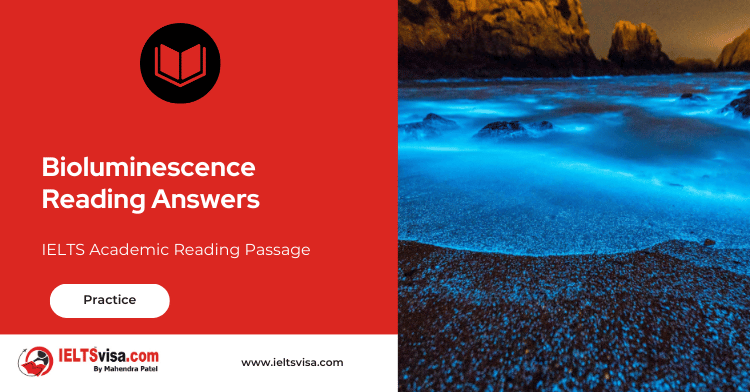
A. In the pitch-black waters of the ocean’s aphotic zone – depths from 1,000m to the seafloor – good eyesight does not count for very much on its own. Caves, in addition, frequently present a similar problem: the complete absence of natural light at any time of the day. This has not stopped some organisms from turning these inhospitable environments into their homes, and in the process, many have created their own forms of light by developing one of the stunning visual marvels of the biological universe—bioluminescence.
B. Many people will encounter bioluminescence at some point in their life, typically in some form of glowworm, which is found on most continents. North and South America are home to the “firefly,” a glowing beetle which is known as a glow-worm during its larvae stage. Flightless glowing beetles and worms are also found in Europe, Asia, Australia, and New Zealand. Less common flies, centipedes, molluscs, and snails have bioluminescent qualities as well, as do some mushrooms. The most dramatic examples of bioluminescence, however, are found deep below the ocean’s surface, where no sunlight can penetrate at all. Here, anglerfish, cookie-cutter sharks, flashlight fish, lantern fish, gulper eels, viperfish, and many other species have developed bioluminescence in unique and creative ways to facilitate their lives.
C. The natural uses of bioluminescence vary widely, and organisms have learnt to be very creative with its use. Fireflies employ bioluminescence primarily for reproductive means – their flashing patterns advertise a firefly’s readiness to breed. Some fish use it as a handy spotlight to help them locate prey. Others use it as a lure; the anglerfish, for example, dangles a luminescent flare that draws in gullible, smaller fishes which get snapped up by the anglerfish in an automated reflex. Sometimes, bioluminescence is used to resist predators. Vampire squids eject a thick cloud of glowing liquid from the tip of their arms when threatened, which can be disorientating. Other species use a single, bright flash to temporarily blind their attacker, with an effect similar to that of an oncoming car which has not dipped its headlights.
D. Humans have captured and utilized bioluminescence by developing, over the last decade, a technology known as Bioluminescence Imaging (BLI). BLI involves the extraction of a DNA protein from a bioluminescent organism, and then the integration of this protein into a laboratory animal through trans-geneticism. Researchers have been able to use luminized pathogens and cancer cell lines to track the respective spread of infections and cancers. Through BLI, cancers and infections can be observed without intervening in a way that affects their independent development. In other words, while an ultra-sensitive camera and bioluminescent proteins add a visual element, they do not disrupt or mutate the natural processes. As a result, when testing drugs and treatments, researchers are permitted a single perspective of a therapy’s progression.
E. Once scientists learn how to engineer bioluminescence and keep it stable in large quantities, a number of other human uses for it will become available. Glowing trees have been proposed as replacements for electric lighting along busy roads, for example, which would reduce our dependence on non-renewable energy sources. The same technology used in Christmas trees for the family home would also eliminate the fire danger from electrical fairy lights. It may also be possible for crops and plants to luminesce when they require watering, and for meat and dairy products to “tell us” when they have become contaminated by bacteria. In a similar way, forensic investigators could detect bacterial species on corpses through bioluminescence. Finally, there is the element of pure novelty. Children’s toys and stickers are often made with glow-in-the-dark qualities, and a biological form would allow rabbits, mice, fish, and other pets to glow as well.
Questions 1 to 5
Reading Passage has five sections, A-E.
Choose the correct heading for sections A-E from the list of headings below.
Write the correct number i-ix in boxes 1-5 on your answer sheet.
List of Headings
i. Mushrooms that glow in the dark
ii. Bright creatures on land and in the sea
iii. Evolution’s solution
iv. Cave-dwelling organisms
v. Future opportunities in biological engineering
vi. Nature’s gift to medicine
vii. Bioluminescence in humans
viii. Purpose of bioluminescence in the wild
ix. Luminescent pets
1 – Section A
2. Section B
3. Section C
4. Section D
5. Section E
Question 6-9
Choose FOUR letters A-G
Write the correct letters in boxes 6-9 on your answer sheet.
Which FOUR uses are listed for bioluminescence in nature?
A. Ways of attracting food
B. Tracing the spread of diseases
C. Mating signals
D. Growing trees for street lighting
E. Drug trials
F. Defensive tactics
G. A torch to identify food
Question 10-13
Sentence Completion
Complete the sentences below.
Choose NO MORE THAN TWO WORDS from the passage for each answer.
Write your answers 10-13 on your answer sheet
10. The luminescent fluid that a vampire squid emits has a …………………… effect on its predator.
11. In order to use bioluminescence in a trans-genetic environment,……………………. must first be removed from a bioluminescent creature.
12. One advantage of BLI is that it could allow researchers to see how a treatment is working without altering or disturbing …………………….
13. In the future, …………………… may be able to use bioluminescence to identify evidence on dead bodies.

Solution For: Bioluminescence
Reading Answers
| 1 – iii | 8 – F |
| 2 – ii | 9 – G |
| 3 – viii | 10 – disorienting |
| 4 – vi | 11 – DNA protein |
| 5 – v | 12 – natural processes |
| 6 – A | 13 – forensic investigators |
| 7 – C |
Review and Practice
- Regularly practice with IELTS reading samples and time yourself to get used to the pressure of the exam.
- Review your mistakes to understand where you went wrong and how to avoid similar errors in the future.
Our Books

Master IELTS Speaking Part 1
IELTS Writing Task 1 Book
IELTS Writing Task 2 Book
Bioluminescence Reading Answers Explanation
Comin Soon
Practice IELTS Other Modules
IELTS Listening
The IELTS Listening test assesses how well you can understand spoken English in various contexts. It lasts about 30 minutes and is divided into four sections with a total of 40 questions. The listening tasks become increasingly difficult as the test progresses.
IELTS Academic Reading
The IELTS Academic Reading section assesses your ability to understand and interpret a variety of texts in academic settings. It is designed to evaluate a range of reading skills, including skimming for gist, reading for main ideas, reading for detail, understanding inferences, and recognizing a writer's opinions and arguments.
IELTS Speaking
The IELTS Speaking test assesses your ability to communicate in English on everyday topics. It lasts 11-14 minutes and consists of three parts: introduction, cue card, and a discussion based on the cue card topic.
IELTS General Reading
IELTS General Reading tests your ability to understand and interpret various types of texts. Here are some key areas and types of content you can expect to encounter in the reading section, along with tips for effective preparation.
IELTS Academic Writing Task 1
In IELTS Academic Writing Task 1, you are presented with a visual representation of information, such as graphs, charts, tables, or diagrams, and you are required to summarize, compare, or explain the data in your own words.
IELTS General Writing Task 1
In IELTS General Writing Task 1, you are required to write a letter based on a given situation. The letter can be formal, semi-formal, or informal, depending on the prompt. Here’s a breakdown of the key components to include in your letter
IELTS Academic Writing Task 2
In IELTS Academic Writing Task 2, you are required to write an essay in response to a question or topic. Here’s a guide to help you understand the essential elements of this task
IELTS Exam Tips
To succeed in the IELTS exam, practice regularly, familiarize yourself with the test format, improve your vocabulary, develop time management skills, and take mock tests to build confidence.
Grammer for IELTS
Grammar is the foundation of effective communication in English. Understanding tense usage, subject-verb agreement, and sentence structure enhances clarity and coherence in writing and speaking.
Vocabulary for IELTS
Vocabulary plays a crucial role in the IELTS (International English Language Testing System) exam, especially in the Speaking and Writing sections. Here’s an overview of why vocabulary is important and how it impacts your performance
RECENT IELTS SAMPLES QUESTIONS AND ANSWERS
Walking with dinosaurs
Peter L. Falkingham and his colleagues at Manchester University are developing techniques that...

Money as the Unit of Amount Reading Answers
The most difficult aspect of money to understand is its function as a unit of account. In...
WEATHERING IN THE DESERT
In the deserts, as elsewhere, rocks at the earth's surface are changed by weathering, which...
Nature on Display in American Zoos
The first zoo in the United States opened in Philadelphia in 1874, followed by the Cincinnati...
Can We Prevent the Poles From Melting
Such is our dependence on fossil fuels, and such is the volume of carbon dioxide we have...

Air conditioning the earth reading answers
The circulation of air in the atmosphere is activated by convection, the transference of heat...
Our IT Company Services