
WHALE STRANDINGS Reading Answers
IELTS Academic Reading Passage
When the last stranded whale of a group eventually dies, the story does not end there. A team of researchers begins to investigate, collecting skin samples for instance, recording anything that could help them answer the crucial question: why? Theories abound, some more convincing than others. In recent years, navy sonar has been accused of causing certain whales to strand. It is known that noise pollution from offshore industry, shipping and sonar can impair underwater communication, but can it really drive whales onto our beaches?
In 1998, researchers at the Pelagos Cetacean Research Institute, a Greek non-profit scientific group, linked whale strandings with low- frequency sonar tests being carried out by the North Atlantic Treaty Organisation (NATO). They recorded the stranding of 12
Cuvier’s beaked whales over 38.2 kilometers of coastline. NATO later admitted it had been testing new sonar technology in the same area at the time as the strandings had occurred. ‘Mass’ whale strandings involve four or more animals. Typically they all wash ashore together, but in mass atypical strandings (such as the one in Greece), the whales don’t strand as a group; they are scattered over a larger area. For humans, hearing a sudden loud noise might prove frightening, but it does not induce mass fatality. For whales, on the other hand, there is a theory on how sonar can kill. The noise can surprise the animal, causing it to swim too quickly to the surface. The result is decompression sickness, a hazard human divers know all too well. If a diver ascends too quickly from a high-pressure underwater environment to a lower-pressure one, gasses dissolved in blood and tissue expand and form bubbles. The bubbles block the flow of blood to vital organs, and can ultimately lead to death.
Plausible as this seems, it is still a theory and based on our more comprehensive knowledge of land-based animals. For this reason, some scientists are wary. Whale expert Karen Evans is one such scientist. Another is Rosemary Gales, a leading expert on whale strandings. She says sonar technology cannot always be blamed for mass strandings. “It’s a case-by-case situation. Whales have been stranding for a very long time – pre-sonar.”
And when 80% of all Australian whale strandings occur around Tasmania, Gales and her team must continue in the search for answers. When animals beach next to each other at the same time, the most common cause has nothing to do with humans at all. “They’re highly social creatures,” says Gales. “When they mass strand – it’s complete panic and chaos. If one of the group strands and sounds the alarm, others will try to swim to its aid, and become stuck themselves.”
Activities such as sonar testing can hint at when a stranding may occur, but if conservationists are to reduce the number of strandings, or improve rescue operations, they need information on where strandings are likely to occur as well. With this in mind, Ralph James, physicist at the University of Western Australia in Perth, thinks he may have discovered why whales turn up only on some beaches. In 1986 he went to Augusta, Western Australia, where more than 100 false killer whales had beached.
“I found out from chatting to the locals that whales had been stranding there for decades. So I asked myself, what is it about this beach?” From this question that James pondered over 20 years ago, grew the university’s Whale Stranding Analysis Project.
Data has since revealed that all mass strandings around Australia occur on gently sloping sandy beaches, some with inclines of less than 0.5%. For whale species that depend on an echolocation system to navigate, this kind of beach spells disaster. Usually, as they swim, they make clicking noises, and the resulting sound waves are reflected in an echo and travel back to them. However, these just fade out on shallow beaches, so the whale doesn’t hear an echo and it crashes onto the shore.
But that is not all. Physics, it appears, can help with the when as well as the where. The ocean is full of bubbles. Larger ones rise quickly to the surface and disappear, whilst smaller ones – called micro bubble – can last for days. It is these that absorb whale ‘clicks! “Rough weather generates more bubbles than usual,” James adds. So, during and after a storm, echolocating whales are essentially swimming blind.
Last year was a bad one for strandings in Australia. Can we predict if this – or any other year – will be any better? Some scientists believe we can. They have found trends which could be used to forecast ‘bad years’ for strandings in the future. In 2005, a survey by
Klaus Vanselow and Klaus Ricklefs of sperm whale strandings in the North Sea even found a correlation between these and the sunspot cycle, and suggested that changes in the Earth’s magnetic field might be involved. But others are skeptical.
“Their study was interesting … but the analyses they used were flawed on a number of levels,” says Evans. In the same year, she co-authored a study on Australian strandings that uncovered a completely different trend. “We analyzed data from 1920 to 2002 … and observed a clear periodicity in the number of whales stranded each year that coincides with a major climatic cycle.” To put it more simply, she says, in the years when strong westerly and southerly winds bring cool water rich in nutrients closer to the Australia coast, there is an increase in the number of fish. The whales follow.
So what causes mass strandings? “It’s probably many different components,” says James. And he is probably right. But the point is we now know what many of those components are.
Questions 14-17
Choose NO MORE THAN TWO WORDS from the passage for each answer.
Write your answers in boxes, 14-17 on your reading answer sheet.
14. What do researchers often take from the bodies of whales?
15. What do some industries and shipping create that are harmful to whales?
16. In which geographical region do most whale strandings in Australia happen?
17. Which kind of whale was the subject of a study in the North Sea?
Questions 18-21
Label the diagram below.
Choose NO MORE THAN TWO WORDS from the passage for each answer.
Write your answers in boxes, 18-21 on your reading answer sheet.
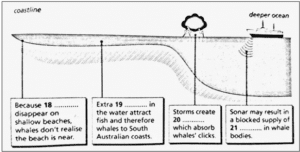
Q.18
Q.19
Q.20
Q.21
Questions 22-26
Do the following statements agree with the information given in Reading Passage 2?
In boxes 22-26 on your reading answer sheet, write:
TRUE – if the statement agrees with the information
FALSE – if the statement contradicts the information
NOT GIVEN – If there is no information on this
Q.22 The aim of the research by the Pelagos Institute in 1998 was to prove that navy sonar was responsible for whale strandings.
Q.23 The whales stranded in Greece were found at different points along the coast.
Q.24 Rosemary Gales has questioned the research techniques used by the Greek scientists.
Q.25 According to Gales, whales are likely to try to help another whale in trouble.
Q.26 There is now agreement amongst scientists that changes in the Earth’s magnetic fields contribute to whale strandings.

Solution For: WHALE STRANDINGS
Reading Answers
| 14. SKIN SAMPLES | 15. NOISE POLLUTION |
| 16. TASMANIA | 17. SPERM WHALE |
| 18. ECHOES | 19. NUTRIENTS |
| 20. MICROBUBBLES | 21. BLOOD |
| 22. FALSE | 23. TRUE |
| 24. NOT GIVEN | 25. TRUE |
| 26. FALSE |
Review and Practice
- Regularly practice with IELTS reading samples and time yourself to get used to the pressure of the exam.
- Review your mistakes to understand where you went wrong and how to avoid similar errors in the future.
Our Books

Master IELTS Speaking Part 1
IELTS Writing Task 1 Book
IELTS Writing Task 2 Book
WHALE STRANDINGS Reading Answers Explanation
Comin Soon
Practice IELTS Other Modules
IELTS Listening
The IELTS Listening test assesses how well you can understand spoken English in various contexts. It lasts about 30 minutes and is divided into four sections with a total of 40 questions. The listening tasks become increasingly difficult as the test progresses.
IELTS Academic Reading
The IELTS Academic Reading section assesses your ability to understand and interpret a variety of texts in academic settings. It is designed to evaluate a range of reading skills, including skimming for gist, reading for main ideas, reading for detail, understanding inferences, and recognizing a writer's opinions and arguments.
IELTS Speaking
The IELTS Speaking test assesses your ability to communicate in English on everyday topics. It lasts 11-14 minutes and consists of three parts: introduction, cue card, and a discussion based on the cue card topic.
IELTS General Reading
IELTS General Reading tests your ability to understand and interpret various types of texts. Here are some key areas and types of content you can expect to encounter in the reading section, along with tips for effective preparation.
IELTS Academic Writing Task 1
In IELTS Academic Writing Task 1, you are presented with a visual representation of information, such as graphs, charts, tables, or diagrams, and you are required to summarize, compare, or explain the data in your own words.
IELTS General Writing Task 1
In IELTS General Writing Task 1, you are required to write a letter based on a given situation. The letter can be formal, semi-formal, or informal, depending on the prompt. Here’s a breakdown of the key components to include in your letter
IELTS Academic Writing Task 2
In IELTS Academic Writing Task 2, you are required to write an essay in response to a question or topic. Here’s a guide to help you understand the essential elements of this task
IELTS Exam Tips
To succeed in the IELTS exam, practice regularly, familiarize yourself with the test format, improve your vocabulary, develop time management skills, and take mock tests to build confidence.
Grammer for IELTS
Grammar is the foundation of effective communication in English. Understanding tense usage, subject-verb agreement, and sentence structure enhances clarity and coherence in writing and speaking.
Vocabulary for IELTS
Vocabulary plays a crucial role in the IELTS (International English Language Testing System) exam, especially in the Speaking and Writing sections. Here’s an overview of why vocabulary is important and how it impacts your performance
RECENT IELTS SAMPLES QUESTIONS AND ANSWERS
Walking with dinosaurs
Peter L. Falkingham and his colleagues at Manchester University are developing techniques that...

Money as the Unit of Amount Reading Answers
The most difficult aspect of money to understand is its function as a unit of account. In...

WEATHERING IN THE DESERT
In the deserts, as elsewhere, rocks at the earth's surface are changed by weathering, which...

Nature on Display in American Zoos
The first zoo in the United States opened in Philadelphia in 1874, followed by the Cincinnati...

Can We Prevent the Poles From Melting
Such is our dependence on fossil fuels, and such is the volume of carbon dioxide we have...

Air conditioning the earth reading answers
The circulation of air in the atmosphere is activated by convection, the transference of heat...
Our IT Company Services