
Active and Passive Voice
Grammar for IELTS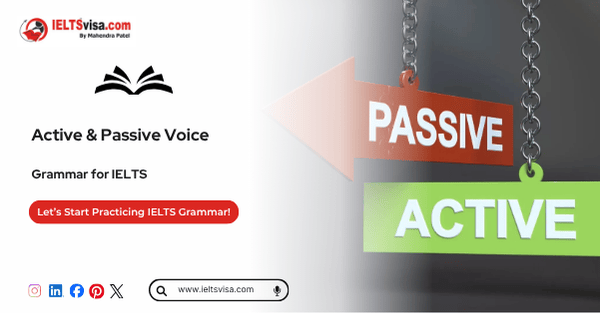
Active and Passive Voice
Understanding the active and passive voice is essential for improving your writing and communication skills. These two forms describe the relationship between the subject, verb, and object in a sentence. In this guide, we will explore the definitions, differences, and rules of active and passive voice, using easy-to-understand examples and practical tips.
What Is Voice in Grammar?
In grammar, voice refers to the form of a verb that shows whether the subject in a sentence is performing or receiving the action. Voice helps convey the focus of a sentence.
- Active Voice: The subject performs the action.
- Passive Voice: The subject receives the action.
Both voices are essential for different types of writing and communication.
Let’s explore their definitions, uses, and differences in detail.
Active Voice – Meaning and Definition
In the active voice, the subject of the sentence is the doer of the action. This voice is direct, clear, and commonly used in everyday writing and speaking.
Definitions:
-
- According to the Oxford Learner’s Dictionary, the active voice is “the form of a verb in which the subject is the person or thing that performs the action.”
- The Collins Dictionary defines it as “a voice of verbs used to indicate that the subject of a sentence is performing the action.”
Examples:
1. “She bakes a cake.” (Subject: She; Verb: bakes; Object: a cake)
2. “The dog chased the cat.”
Passive Voice – Meaning and Definition
In the passive voice, the subject of the sentence is the receiver of the action. This form is often used when the doer of the action is unknown or unimportant.
Definitions:
-
- According to the Oxford Learner’s Dictionary, the passive voice is “the form of a verb used when the subject is affected by the action of the verb.”
- The Collins Dictionary states that the passive voice “is formed using ‘be’ and the past participle of a verb. The subject of a passive clause does not perform the action expressed by the verb but is affected by it.”
Examples:
1. “The cake was baked by her.” (Subject: The cake; Verb: was baked; Agent: by her)
2. “The cat was chased by the dog.”
Key Differences Between Active and Passive Voice
|
Active Voice |
Passive Voice |
|
The subject performs the action. |
The subject receives the action. |
|
Direct and straightforward tone. |
Indirect and subtle tone. |
|
Example: “She writes a letter.” |
Example: “A letter is written by her.” |
|
Focuses on the doer of the action. |
Focuses on the action or the receiver. |
|
Does not require auxiliary verbs. |
Requires auxiliary verbs (e.g., is, was, has). |
When to Use Active and Passive Voice
Active Voice:
-
- When clarity and simplicity are needed.
- In conversational and informal writing.
- For direct instructions or commands.
Examples:
-
- “Clean your room.”
- “He solved the puzzle.”
Passive Voice:
-
- When the doer of the action is unknown or unimportant.
- To emphasize the action or the receiver of the action.
- In formal writing, such as scientific papers.
Examples:
-
- “The results were published yesterday.”
- A mistake was made during the experiment.”
Rules for Converting Active Voice to Passive Voice
1. Identify the Subject, Verb, and Object:
-
- Active: “She writes a book.” (Subject: She; Verb: writes; Object: a book)
- Passive: “A book is written by her.”
2. Switch the Subject and Object:
-
- Move the object of the active sentence to the subject position.
3. Change the Verb Form:
-
- Use the appropriate tense of the auxiliary verb “be” + past participle of the main verb.
4. Use “by” to Indicate the Doer (Optional):
-
- In passive sentences, the doer can be introduced with “by.” However, it is often omitted if the doer is unknown or irrelevant.
Examples of Conversion:
|
Tense |
Active Voice |
Passive Voice |
|
Present Simple |
“He writes a letter.” |
“A letter is written by him.” |
|
Past Simple |
“She painted the house.” |
“The house was painted by her.” |
|
Future Simple |
“They will finish the project.” |
“The project will be finished by them.” |
|
Present Continuous |
“He is reading a book.” |
“A book is being read by him.” |
|
Present Perfect |
“She has completed the task.” |
“The task has been completed by her.” |
Pronoun Changes in Active and Passive Voice
When converting sentences, pronouns change as follows:
|
Active Voice |
Passive Voice |
|
I |
Me |
|
We |
Us |
|
He |
Him |
|
She |
Her |
|
They |
Them |
|
It |
It |
Examples:
-
- Active: “I gave him a gift.”
- Passive: “A gift was given to him by me.”
Examples of Active and Passive Voice
Present Tense:
- Active: “She opens the door.” Passive: “The door is opened by her.”
- Active: “They are cleaning the house.” Passive: “The house is being cleaned by them.”
Past Tense:
- Active: “He wrote the report.” Passive: “The report was written by him.”
- Active: “They were making dinner.” Passive: “Dinner was being made by them.”
Future Tense:
- Active: “She will deliver the speech.” Passive: “The speech will be delivered by her.”
- Active: “They will complete the assignment.” Passive: “The assignment will be completed by them.”
Practice Exercise
Convert the following sentences as directed:
1. Active: “He is repairing the car.” (Change to passive voice)
2. Passive: “The letter was sent by her.” (Change to active voice)
3. Active: “They have solved the problem.” (Change to passive voice)
4. Passive: “The book will be published by the author.” (Change to active voice)
5. Active: “I gave her a gift.” (Change to passive voice)
Answers:
1. Passive: “The car is being repaired by him.”
2. Active: “She sent the letter.”
3. Passive: “The problem has been solved by them.”
4. Active: “The author will publish the book.”
5. Passive: “A gift was given to her by me.”
Tips for Mastering Active and Passive Voice
- Focus on the Subject: Identify whether the subject is performing or receiving the action.
- Understand Verb Forms: Practice using the past participle form of verbs.
- Keep It Clear: Use active voice for direct communication and passive voice for emphasis.
- Practice Regularly: Convert sentences between active and passive voice to gain confidence.

Our Books

Master IELTS Speaking Part 1
IELTS Writing Task 1 Book
IELTS Writing Task 2 Book
Practice IELTS Other Modules
IELTS Listening
The IELTS Listening test assesses how well you can understand spoken English in various contexts. It lasts about 30 minutes and is divided into four sections with a total of 40 questions. The listening tasks become increasingly difficult as the test progresses.
IELTS Academic Reading
The IELTS Academic Reading section assesses your ability to understand and interpret a variety of texts in academic settings. It is designed to evaluate a range of reading skills, including skimming for gist, reading for main ideas, reading for detail, understanding inferences, and recognizing a writer's opinions and arguments.
IELTS Speaking
The IELTS Speaking test assesses your ability to communicate in English on everyday topics. It lasts 11-14 minutes and consists of three parts: introduction, cue card, and a discussion based on the cue card topic.
IELTS General Reading
IELTS General Reading tests your ability to understand and interpret various types of texts. Here are some key areas and types of content you can expect to encounter in the reading section, along with tips for effective preparation.
IELTS Academic Writing Task 1
In IELTS Academic Writing Task 1, you are presented with a visual representation of information, such as graphs, charts, tables, or diagrams, and you are required to summarize, compare, or explain the data in your own words.
IELTS General Writing Task 1
In IELTS General Writing Task 1, you are required to write a letter based on a given situation. The letter can be formal, semi-formal, or informal, depending on the prompt. Here’s a breakdown of the key components to include in your letter
IELTS Academic Writing Task 2
In IELTS Academic Writing Task 2, you are required to write an essay in response to a question or topic. Here’s a guide to help you understand the essential elements of this task
IELTS Exam Tips
To succeed in the IELTS exam, practice regularly, familiarize yourself with the test format, improve your vocabulary, develop time management skills, and take mock tests to build confidence.
Grammer for IELTS
Grammar is the foundation of effective communication in English. Understanding tense usage, subject-verb agreement, and sentence structure enhances clarity and coherence in writing and speaking.
Vocabulary for IELTS
Vocabulary plays a crucial role in the IELTS (International English Language Testing System) exam, especially in the Speaking and Writing sections. Here’s an overview of why vocabulary is important and how it impacts your performance
RECENT IELTS SAMPLES QUESTIONS AND ANSWERS
IELTS Speaking Part 1 – Favourite Sujbect – Physics
IELTS Speaking Part 1 - Favourite Sujbect - Physics Q: What is your favourite subject? A: My favourite subject...
IELTS Speaking Part 1 – Present Situation (Student)
IELTS Speaking Part 1 - Present Situation (Student) Q1: Are you a student or do you work?A: I’m a full-time...
IELTS Speaking Part 1 – Present Situation – Employee – as an International Student and Social Worker
IELTS Speaking Part 1 - Present Situation - Employee - as an International Student and Social Worker Q1: Are...

IELTS Speaking Part 1 – Persent Situation – Employee- as an Electric Engineer
IELTS Speaking Part 1 - Persent Situation - Employee- as an Electric Engineer Q1: What do you do for a...
IELTS Speaking Part 1 – Persent Situation – Employee – as an Software Engineer
IELTS Speaking Part 1 - Persent Situation - Employee - as an Software Engineer Q1: What do you do for a...
IELTS Speaking Part 1 – Persent Situation – Married
IELTS Speaking Part 1 - Persent Situation - Married Q1: Are you married?A: Yes, I am married. My spouse and I...
Our IT Company Services