
Forming Adjectives
Grammar for IELTS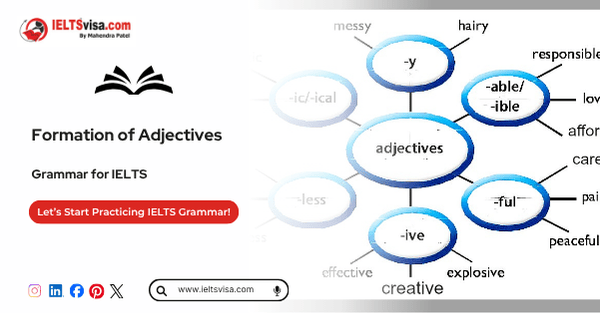
Forming Adjectives Definition, Forms, Types, Usage, and Examples
Adjectives are essential in English as they add flavour to your sentences by describing nouns or pronouns. But have you ever wondered how adjectives are formed? This guide explains the various ways adjectives can be created, outlines the rules to follow and provides examples to make it easy for learners of all ages.
Table of Contents
- What Are Adjectives?
- Typical Adjective Endings
- Rules for Forming Adjectives
- Forming Adjectives from Nouns, Verbs, and Adjectives
- Examples of Forming Adjectives
- Practice Exercises
- Frequently Asked Questions
What Are Adjectives?
Adjectives are words that describe or modify a noun or pronoun. They tell us more about the qualities, quantity, or characteristics of a noun.
Examples:
-
- The beautiful sunset amazed everyone.
- He gave a helpful answer.
- The weather is windy today.
Typical Adjective Endings
Some adjectives are easily recognizable by their endings. Here are common adjective endings:
1. -able / -ible: readable, incredible
2. -al: functional, natural
3. -ful: beautiful, helpful
4. -ic: artistic, terrific
5. -ive: creative, attractive
6. -less: hopeless, sleeveless
7. -ous: dangerous, fabulous
Rules for Forming Adjectives
When forming adjectives, certain changes might be needed. Here are some common rules and exceptions:
|
Add |
Exceptions |
Word |
Adjective |
|
-al |
Drop ‘e’ if ending in ‘e’ |
Nature, Function |
Natural, Functional |
|
-y |
Drop ‘e’ if ending in ‘e’ |
Ice, Oil |
Icy, Oily |
|
-ful |
Change ‘y’ to ‘i’ if ending in ‘y’ |
Beauty, Peace |
Beautiful, Peaceful |
|
-ous/-ious |
Drop ‘y’ if ending in ‘y’ |
Mystery, Danger |
Mysterious, Dangerous |
|
-ic |
Drop ‘y’ if ending in ‘y’ |
History, Rust |
Historic, Rustic |
Forming Adjectives from Nouns, Verbs, and Other Adjectives
Adjectives can be formed from various parts of speech, including nouns, verbs, and even other adjectives.
1. From Nouns
Convert a noun into an adjective to describe a related quality.
Examples:
-
- Accident → Accidental
- Danger → Dangerous
- Star → Starry
2. From Verbs
Adjectives can also come from verbs, often describing the action as a quality.
Examples:
-
- Enjoy → Enjoyable
- Talk → Talkative
- Help → Helpful
3. From Other Adjectives
Sometimes adjectives are modified to create new adjectives.
Examples:
-
- Comic → Comical
- Red → Reddish
- Sick → Sickly
Examples of Forming Adjectives
Here are some practical examples of forming adjectives in sentences:
1. Noun to Adjective:
-
-
-
- Noun: wind → Adjective: windy
- It’s a windy day today.
-
-
2. Verb to Adjective:
-
-
-
- Verb: help → Adjective: helpful
- She gave a helpful suggestion.
-
-
3. Adjective to Adjective:
-
-
-
- Adjective: red → Adjective: reddish
- The dress was a reddish color.
-
-
Practice Exercises
Try these exercises to test your understanding of forming adjectives.
1. Choose the Adjective
Identify the adjective in each group of words:
A. Inventive, Invent, Invented
B. Curiosity, Curious, Curiousive
C. Proliferate, Prolific, Proud
Answers:
A. Inventive
B. Curious
C. Prolific
2. Form Adjectives from Nouns
Convert the following nouns into adjectives:
A. Magic
B. Lady
C. Fool
Answers:
A. Magical
B. Ladylike
C. Foolish
3. Form Adjectives from Verbs
Convert these verbs into adjectives:
A. Talk
B. Improve
C. Annoy
Answers:
A. Talkative
B. Improved
C. Annoying
Frequently Asked Questions
Q1: How are adjectives formed from nouns?
Adjectives are formed from nouns by adding suffixes like -al, -ful, -y, or -ous. For example, beauty becomes beautiful.
Q2: Can verbs be turned into adjectives?
Yes, verbs can become adjectives by adding endings like -able, -ive, or -ing. For instance, help becomes helpful.
Q3: What are examples of adjectives formed from other adjectives?
Examples include red → reddish and comic → comical.

Our Books

Master IELTS Speaking Part 1
IELTS Writing Task 1 Book
IELTS Writing Task 2 Book
Practice IELTS Other Modules
IELTS Listening
The IELTS Listening test assesses how well you can understand spoken English in various contexts. It lasts about 30 minutes and is divided into four sections with a total of 40 questions. The listening tasks become increasingly difficult as the test progresses.
IELTS Academic Reading
The IELTS Academic Reading section assesses your ability to understand and interpret a variety of texts in academic settings. It is designed to evaluate a range of reading skills, including skimming for gist, reading for main ideas, reading for detail, understanding inferences, and recognizing a writer's opinions and arguments.
IELTS Speaking
The IELTS Speaking test assesses your ability to communicate in English on everyday topics. It lasts 11-14 minutes and consists of three parts: introduction, cue card, and a discussion based on the cue card topic.
IELTS General Reading
IELTS General Reading tests your ability to understand and interpret various types of texts. Here are some key areas and types of content you can expect to encounter in the reading section, along with tips for effective preparation.
IELTS Academic Writing Task 1
In IELTS Academic Writing Task 1, you are presented with a visual representation of information, such as graphs, charts, tables, or diagrams, and you are required to summarize, compare, or explain the data in your own words.
IELTS General Writing Task 1
In IELTS General Writing Task 1, you are required to write a letter based on a given situation. The letter can be formal, semi-formal, or informal, depending on the prompt. Here’s a breakdown of the key components to include in your letter
IELTS Academic Writing Task 2
In IELTS Academic Writing Task 2, you are required to write an essay in response to a question or topic. Here’s a guide to help you understand the essential elements of this task
IELTS Exam Tips
To succeed in the IELTS exam, practice regularly, familiarize yourself with the test format, improve your vocabulary, develop time management skills, and take mock tests to build confidence.
Grammer for IELTS
Grammar is the foundation of effective communication in English. Understanding tense usage, subject-verb agreement, and sentence structure enhances clarity and coherence in writing and speaking.
Vocabulary for IELTS
Vocabulary plays a crucial role in the IELTS (International English Language Testing System) exam, especially in the Speaking and Writing sections. Here’s an overview of why vocabulary is important and how it impacts your performance
RECENT IELTS SAMPLES QUESTIONS AND ANSWERS
IELTS Speaking Part 1 – Favourite Sujbect – Physics
IELTS Speaking Part 1 - Favourite Sujbect - Physics Q: What is your favourite subject? A: My favourite subject...
IELTS Speaking Part 1 – Present Situation (Student)
IELTS Speaking Part 1 - Present Situation (Student) Q1: Are you a student or do you work?A: I’m a full-time...
IELTS Speaking Part 1 – Present Situation – Employee – as an International Student and Social Worker
IELTS Speaking Part 1 - Present Situation - Employee - as an International Student and Social Worker Q1: Are...

IELTS Speaking Part 1 – Persent Situation – Employee- as an Electric Engineer
IELTS Speaking Part 1 - Persent Situation - Employee- as an Electric Engineer Q1: What do you do for a...
IELTS Speaking Part 1 – Persent Situation – Employee – as an Software Engineer
IELTS Speaking Part 1 - Persent Situation - Employee - as an Software Engineer Q1: What do you do for a...
IELTS Speaking Part 1 – Persent Situation – Married
IELTS Speaking Part 1 - Persent Situation - Married Q1: Are you married?A: Yes, I am married. My spouse and I...
Our IT Company Services