
IELTS Speaking Part 1 – Reading
IELTS Speaking Practice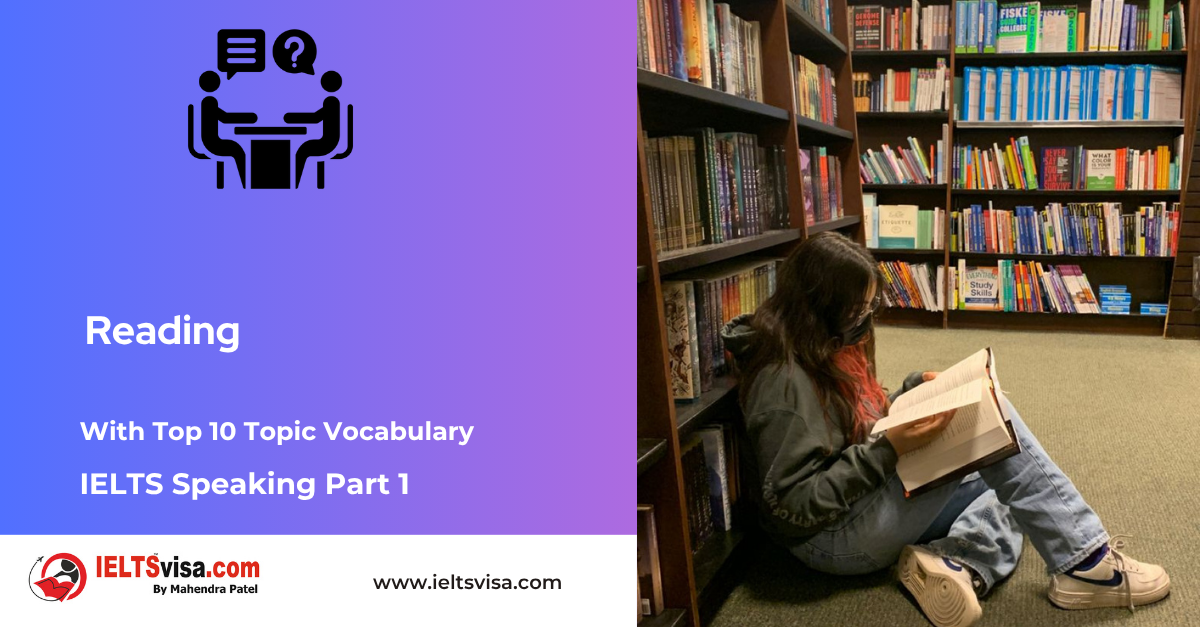
IELTS Speaking Part 1 – Reading
Examiner: Do you enjoy reading?
Candidate: Yes, I definitely enjoy reading! It’s a fantastic way to learn new things, explore different worlds, and unwind after a busy day. I find the process of getting lost in a good book incredibly relaxing and stimulating.
Examiner: What kind of books do you prefer to read?
Candidate: My reading preferences vary depending on my mood. Sometimes, I crave fiction like fantasy or mystery, allowing me to escape into a captivating story. Other times, I might choose non-fiction like biographies or historical accounts to expand my knowledge on a particular topic.
Examiner: Where do you usually read?
Candidate: I enjoy reading in different settings. I might curl up in a comfortable chair with a good book at home. For shorter reads, I might utilize my commute on public transport. Reading outdoors in a park or by the beach can also be a very refreshing experience.
Examiner: How often do you read?
Candidate: I try to incorporate reading into my daily routine whenever possible. Even if it’s just for a short period before bed or during a coffee break, dedicating some time to reading helps me stay engaged and mentally stimulated.
Examiner: Do you ever read newspapers or magazines?
Candidate: I do! While I often rely on online news sources, physical newspapers or magazines offer in-depth articles and curated content on various topics. They can be a great way to stay informed and explore subjects that pique my interest.
Examiner: Have you ever joined a book club?
Candidate: I have joined a book club before. Discussing books with others and exploring different perspectives was a great experience. It added another layer of enjoyment to my reading experience, and I learned a lot from the discussions.
Examiner: Do you think reading is an important skill?
Candidate: Absolutely! Reading is a fundamental skill with numerous benefits. It enhances vocabulary, improves critical thinking and comprehension abilities, and broadens our knowledge base. Strong reading skills are essential for success in education and throughout life.
Examiner: Do you think people read less nowadays because of technology?
Candidate: There might be some truth to that. The abundance of digital distractions and instant entertainment offered by technology can compete with the time dedicated to reading traditional books. However, many people still prioritize reading and even utilize e-readers and audiobooks to fit reading into their busy lives.
Examiner: How do you think libraries can encourage people to read more?
Candidate: Libraries play a crucial role in promoting reading. By offering a vast collection of books in various formats, hosting author talks and book clubs, and providing reading programs for children, libraries can create a vibrant space for fostering a love of reading.
Examiner: Do you think reading can change how we think about the world?
Candidate: Absolutely! Exposure to different perspectives, ideas, and cultures through reading can broaden our understanding of the world. Reading can challenge our beliefs, spark curiosity about new topics, and ultimately shape how we perceive the world around us.
Examiner: Do you ever find it difficult to concentrate when reading?
Candidate: Yes, it can happen! Focusing on reading can be challenging, especially in noisy environments or when feeling particularly distracted. Finding a quiet space and minimizing distractions like phones can significantly improve concentration. Also, choosing a book that genuinely interests you can enhance your focus.
Examiner: Do you think finishing every book you start reading is important?
Candidate: Absolutely! Exposure to different perspectives, ideas, and cultures through reading can broaden our understanding of the world. Reading can challenge our beliefs, spark curiosity about new topics, and ultimately shape how we perceive the world around us.
Examiner: Do you ever find it difficult to concentrate when reading?
Candidate: Yes, it can happen! Focusing on reading can be challenging, especially in noisy environments or when feeling particularly distracted. Finding a quiet space and minimizing distractions like phones can significantly improve concentration. Also, choosing a book that genuinely interests you can enhance your focus.
Examiner: Do you think finishing every book you start reading is important?
Candidate: Not necessarily! Sometimes, a book might not resonate with your taste or learning goals. Life is too short to force yourself through an unenjoyable read. Don’t hesitate to abandon books that don’t captivate you and move on to something that sparks your interest.
Examiner: Do you prefer reading physical books or e-books?
Candidate: I enjoy both formats! Physical books offer a tactile experience and the satisfaction of turning pages. However, e-books offer advantages like portability, instant access to a vast library, and adjustable font size. Ultimately, my preference depends on the situation and reading material.
Examiner: Do you think reading can help you improve your writing skills?
Candidate: Absolutely! Reading exposes you to different writing styles, vocabulary usage, and sentence structures. The more you read well-written content, the more it subconsciously influences your own writing skills. Over time, you’ll develop a stronger command of language and a more polished writing style.
Examiner: Do you think it’s important to encourage children to read from a young age?
Candidate: Absolutely! Fostering a love of reading early on sets a valuable foundation for lifelong learning. Reading exposes children to new vocabulary, stimulates their imagination, and helps develop critical thinking skills. Parents and caregivers can encourage reading by creating a stimulating reading environment, reading aloud together, and making frequent library visits.
Top 10 Topic Vocabulary for “Reading”
|
Vocabulary |
Type |
Meaning |
Synonyms |
Antonyms |
Word Family |
Example Sentences |
|
Comprehension |
Noun |
The ability to understand something. |
Understanding, grasp |
Misunderstanding |
Comprehend (v), Comprehensive (adj) |
1. Reading regularly helps improve comprehension skills. |
|
Genre |
Noun |
A category of artistic composition characterized by similarities in form or style. |
Category, type |
– |
Genre (n), Generic (adj) |
1. My favourite genre of books is science fiction. |
|
Vocabulary |
Noun |
The body of words used in a particular language or by a specific group of people. |
Lexicon, terminology |
– |
Vocabulary (n), Vocable (n) |
1. Reading diverse materials can expand your vocabulary significantly. |
|
Narrative |
Noun |
A spoken or written account of connected events; a story. |
Story, tale |
– |
Narrate (v), Narrator (n) |
1. The novel’s narrative structure kept me engaged until the end. |
|
Fiction |
Noun |
Literature that describes imaginary events and people. |
Fantasy, storytelling |
Non-fiction |
Fictional (adj), Fictionalize (v) |
1. Fiction allows readers to explore new worlds and ideas. |
|
Literacy |
Noun |
The ability to read and write. |
Education, learning |
Illiteracy |
Literate (adj), Literature (n) |
1. Literacy is a fundamental skill that opens up opportunities for lifelong learning. |
|
Audiobook |
Noun |
A recording of a book being read aloud. |
– |
– |
Audio (adj), Audiobooks (n) |
1. Audiobooks are a convenient way to enjoy literature while multitasking. |
|
E-book |
Noun |
A book publication made available in digital form, readable on electronic devices. |
Digital book, eReader |
Physical book |
E-book (n), E-reader (n) |
1. E-books provide instant access to a vast library of titles. |
|
Book Club |
Noun |
A group of people who meet regularly to discuss books they have all read. |
Reading group, discussion circle |
– |
– |
1. Joining a book club is a great way to meet people and share your love of reading. |
|
Non-fiction |
Noun |
Prose writing that is informative or factual rather than fictional. |
Factual, Documentary |
Fiction |
Non-fictional (adj), Non-fiction (n) |
1. Non-fiction books like biographies and historical accounts are great for learning new information. |


Our Books

Master IELTS Speaking Part 1
IELTS Writing Task 1 Book
IELTS Writing Task 2 Book
Practice IELTS Other Modules
IELTS Listening
The IELTS Listening test assesses how well you can understand spoken English in various contexts. It lasts about 30 minutes and is divided into four sections with a total of 40 questions. The listening tasks become increasingly difficult as the test progresses.
IELTS Academic Reading
The IELTS Academic Reading section assesses your ability to understand and interpret a variety of texts in academic settings. It is designed to evaluate a range of reading skills, including skimming for gist, reading for main ideas, reading for detail, understanding inferences, and recognizing a writer's opinions and arguments.
IELTS Speaking
The IELTS Speaking test assesses your ability to communicate in English on everyday topics. It lasts 11-14 minutes and consists of three parts: introduction, cue card, and a discussion based on the cue card topic.
IELTS General Reading
IELTS General Reading tests your ability to understand and interpret various types of texts. Here are some key areas and types of content you can expect to encounter in the reading section, along with tips for effective preparation.
IELTS Academic Writing Task 1
In IELTS Academic Writing Task 1, you are presented with a visual representation of information, such as graphs, charts, tables, or diagrams, and you are required to summarize, compare, or explain the data in your own words.
IELTS General Writing Task 1
In IELTS General Writing Task 1, you are required to write a letter based on a given situation. The letter can be formal, semi-formal, or informal, depending on the prompt. Here’s a breakdown of the key components to include in your letter
IELTS Academic Writing Task 2
In IELTS Academic Writing Task 2, you are required to write an essay in response to a question or topic. Here’s a guide to help you understand the essential elements of this task
IELTS Exam Tips
To succeed in the IELTS exam, practice regularly, familiarize yourself with the test format, improve your vocabulary, develop time management skills, and take mock tests to build confidence.
Grammer for IELTS
Grammar is the foundation of effective communication in English. Understanding tense usage, subject-verb agreement, and sentence structure enhances clarity and coherence in writing and speaking.
Vocabulary for IELTS
Vocabulary plays a crucial role in the IELTS (International English Language Testing System) exam, especially in the Speaking and Writing sections. Here’s an overview of why vocabulary is important and how it impacts your performance
RECENT IELTS SAMPLES QUESTIONS AND ANSWERS
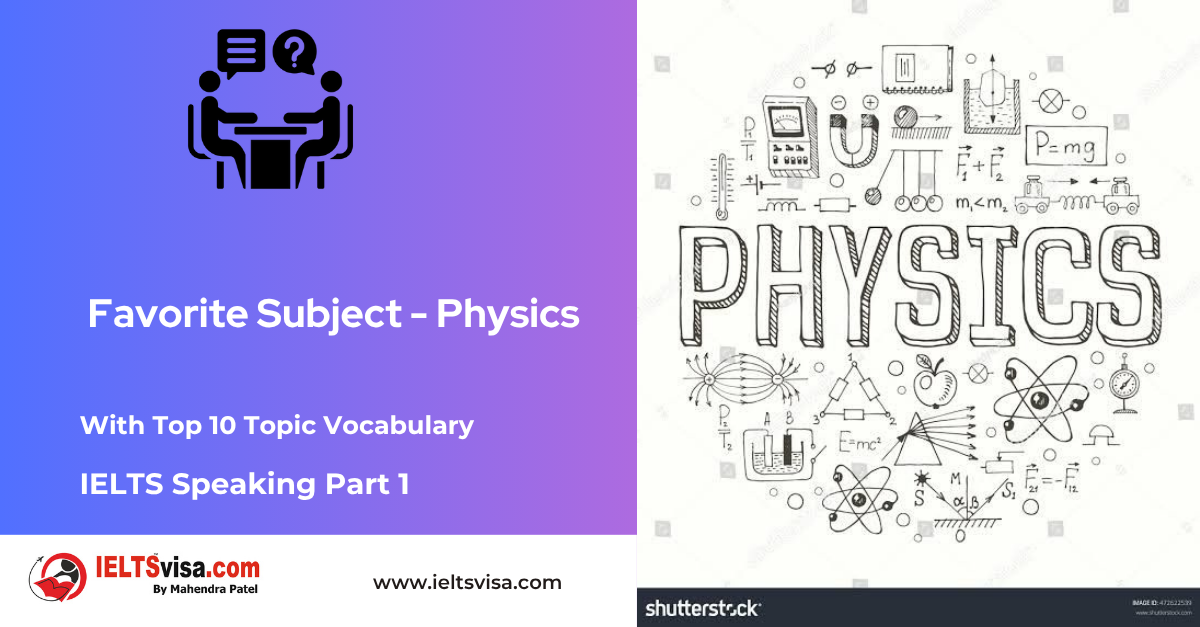
IELTS Speaking Part 1 – Favourite Sujbect – Physics
IELTS Speaking Part 1 - Favourite Sujbect - Physics Q: What is your favourite subject? A: My favourite subject...
IELTS Speaking Part 1 – Present Situation (Student)
IELTS Speaking Part 1 - Present Situation (Student) Q1: Are you a student or do you work?A: I’m a full-time...
IELTS Speaking Part 1 – Present Situation – Employee – as an International Student and Social Worker
IELTS Speaking Part 1 - Present Situation - Employee - as an International Student and Social Worker Q1: Are...

IELTS Speaking Part 1 – Persent Situation – Employee- as an Electric Engineer
IELTS Speaking Part 1 - Persent Situation - Employee- as an Electric Engineer Q1: What do you do for a...
IELTS Speaking Part 1 – Persent Situation – Employee – as an Software Engineer
IELTS Speaking Part 1 - Persent Situation - Employee - as an Software Engineer Q1: What do you do for a...
IELTS Speaking Part 1 – Persent Situation – Married
IELTS Speaking Part 1 - Persent Situation - Married Q1: Are you married?A: Yes, I am married. My spouse and I...
Our IT Company Services